The fig tree metaphor
The Bell JarThe fig tree metaphor is the novel’s central image of possibility becoming loss. Through the story of a Jewish man and a nun who part ways, and then through Esther Greenwood’s vision of her own futures, the tree makes the cost of choice palpable: every desirable life seems to require giving up the others, while indecision lets them disappear altogether.
The Story Beneath the Tree
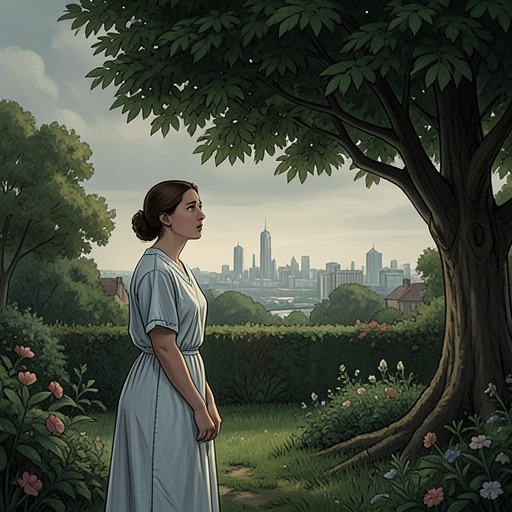
The image first comes to Esther in a short story she reads while ill. A fig tree grows on a green lawn between the house of a Jewish man and a convent. The man and a beautiful, dark-haired nun meet there to gather ripe figs. Their closeness is conveyed through a small, tentative gesture: while watching a bird hatch in a nest on a branch, they touch the backs of their hands together.
The encounter does not settle into a shared life. The nun stops coming to pick figs, and a mean-faced Catholic kitchen maid takes her place. She counts the figs the man has picked, making sure he has not taken more than she has. The man is furious. The change from the nun’s quiet companionship to the maid’s suspicious accounting turns the tree from a place of intimacy into a scene of separation and grievance.
Esther loves the story’s seasonal movement: the tree stands beneath snow in winter, then bears green fruit in spring. She is saddened when she reaches its last page, and longs to enter the printed story and sleep beneath the great green tree. That wish expresses more than pleasure in a beautiful image: the tree offers imaginative shelter at a moment when Esther feels lonely and weak.
A Shared Past and a Separation
Esther reads the story through her relationship with Buddy Willard. She thinks that she and Buddy were like the Jewish man and the nun—not because they shared the story’s religious identities, since both were Unitarian, but because they had met beneath an imagined tree of their own. What they saw together, she reflects, was not a bird hatching but a baby emerging from a woman. Then something awful happened, and they went their separate ways.
The parallel does not make Esther and Buddy exact counterparts of the figures in the story. Instead, it gives Esther a compact way to look back on an intimacy that has broken apart. The tree holds both the tenderness of shared attention and the possibility that closeness can end, leaving another person—or a stranger—to occupy the place once shared.
Futures That Cannot Be Chosen
Later, Esther turns the story’s tree into a picture of her own life. She sees her future branching out, with a wonderful possibility beckoning from every branch like a fat purple fig. The imagined futures are strikingly varied: a husband, happy home, and children; becoming a famous poet or a brilliant professor; becoming Ee Gee, the amazing editor; traveling in Europe, Africa, and South America; lovers with unusual names and unconventional professions; and becoming an Olympic lady crew champion. Other figs remain indistinct beyond those she can name.
The abundance is the source of the crisis, not its cure. Esther wants each future, but understands that choosing one means losing all the rest. The tree makes that loss feel material: while she sits in its crotch, unable to decide, the figs wrinkle, turn black, and fall one by one to the ground. Her image is not simply a catalogue of ambitions. It stages the frightening interval between seeing many possible lives and committing to one, when the desire to preserve every option can leave none within reach.
The metaphor also marks a change in how Esther understands the end of her earlier prospects. She thinks of herself as a racehorse without racetracks, or a champion college footballer confronted by Wall Street and a business suit; past victories have shrunk to a little gold cup bearing a date like one on a tombstone. Against that sense that the era of scholarships and prizes is ending, the figs promise many lives. Yet possibility alone does not restore direction: their ripening gives way to decay as Esther remains unable to choose.
Recurrence and Significance
The tree’s meaning is shaped by a contrast between its two appearances. In the story Esther reads, the cycle of winter and spring carries the promise of renewal, even as the nun’s disappearance leaves a loss that cannot be undone. In Esther’s own vision, fruit signifies futures she can imagine but cannot all inhabit; the figs do not wait indefinitely for her decision. The same image therefore joins the hope of abundance to the pain of finitude.
Near the novel’s close, Esther remembers the story of the fig tree among a crowded landscape of experiences: the cadavers, Doreen, Marco’s diamond, the sailor on Boston Common, Doctor Gordon’s wall-eyed nurse, broken thermometers, a man with two kinds of beans, the twenty pounds she gained on insulin, and a rock bulging between sky and sea like a gray skull. She wonders whether forgetfulness might cover these memories like snow, but concludes that they are part of her landscape. The fig-tree story is thus not only an image of the choice she once could not make; it is one of the memories that remain part of the self through which she continues. Its enduring force lies in holding possibility, missed futures, and painful recollection together without pretending that any can simply erase the others.